Collage Artist Anika Toro Discusses the Ceation of Her Visual Poetry Art Book, Finding Joy
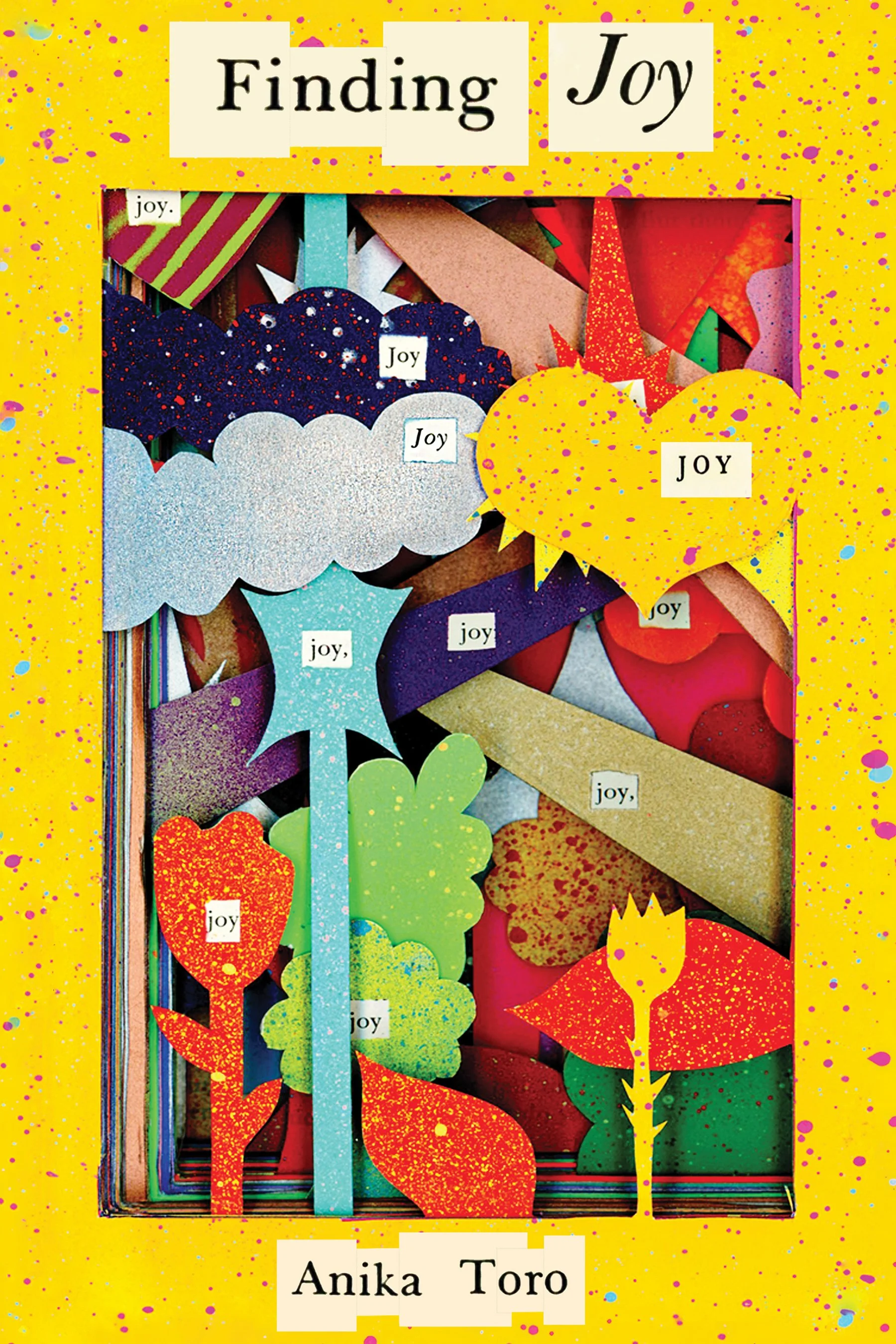
Anika Toro is a mixed media artist with a background in photography and collage. Her current work fuses narrative, serendipity, and playful experimentation into art that transforms familiar texts and images into unexpected expressions of creativity. Her innovative projects have found homes in hotels and private spaces around the world, while her award-winning photography has been seen in magazines, on record covers, and in exhibitions throughout the United States.
In her debut book, Finding Joy, Anika offers an intimate look at her creative journey—a path of wonder, discovery, and those unexpected twists that make art so fun and magical. When not in her studio, Anika finds inspiration in music, nature, tarot, and time with her family. She lives in Tennessee with her husband, teenage daughter, and their much-loved cat.
Here, Anika talks with Tricia Reeks, founder of Meerkat Press and Finding Joy’s publisher, about this amazing project.
You’re about to publish a book of mixed media art and found poetry, but you’ve said you never intended to make a book at all. How did this project begin?
It started as an attempt to make more freely. I was feeling like I put a lot of judgement and constraints onto my making practice. I wanted to change that as well as experiment with breaking rules I had learned from the art world and art school. I wanted to make space for the unexpected and unknown. It was 2021. I was working in solitude with no audience in mind, which gave me a unique environment to do all of that. Around that time, I was also wanting to explore joy in a more meaningful way. One afternoon I asked aloud, “What can I do to bring more joy into my life?” And there in a stack of books I intended to repurpose, was the inherited copy of Invitation to Joy by Eleanor Searle Whitney. It felt like an answer. So, I began to play.
Many people cringe at the idea of tearing apart a book. Was that difficult for you?
For most of my life, yes, but not then. A couple of years earlier, I had started making collage specifically to teach myself not to be so precious about things. My husband and I had inherited two estates back- to- back, and our home was suddenly full of other people’s belongings. It changed how I thought about objects and what we leave behind. Eventually we decided that if we kept anything it would have to become part of us as well. How do we honor something we had no attachment to and why? Then I asked the same of what I would leave behind to my own daughter. I began writing in the books I read. I began leaving notes to my daughter in the margins, leaving breadcrumbs in the sleeves of records, adding our doodles and art to existing pictures. By the time I started this project, altering a book didn’t feel destructive; it felt like honoring it in a new way.
When did the found poetry element enter the picture?
Honestly, not until I reached the first page of the actual text. I had already added collage and interactive elements, but when I turned past the title and dedication pages, the first word that jumped out was “Art.” A few lines down: “making in delight.” It felt like the book was speaking directly to what I was trying to call into my life. That moment, those words, became the catalyst for the entire body of work.
And this became a daily practice?
Almost immediately. Every day I opened the book, something showed up—a phrase, an image, a coincidence that felt like a nudge. One day the words “King Kong” appeared, and I happened to have an image of King Kong on my desk from a collage I’d planned. That kind of thing kept happening. It taught me that my process takes time to build. I’ll find an image and set it aside, and a day, a week, even a year later it becomes the perfect companion to a new set of words. It requires faith in timing, in confluence, in paying attention to what wants to be made. For me, there is a kind of trust necessary in order for Serendipity to show up and play—It’s addictive.
At some point, the project shifted. What changed?
About halfway through the first book, I wanted to hone my skills. I had started by breaking rules—ignoring the stigma around appropriation, letting things be messy—but then I wanted cleaner edges, more intention, and I wanted to experiment with different ways to play with the ideas of narrative. I began experimenting: could I make a collage first and then search for the words that supported it? Could the magic work in reverse? It did. That led to multiple editions—a haiku edition inspired by my aunt, an edition to explore introspection and personal reflection, and the TEAR edition, which honored artists like Tom Phillips, Mary Ruffle, and Austin Kleon. Currently I have eleven books in rotation.
How did the work move from a private practice to something you wanted to publish?
I didn’t plan that either. Two years into the project, I attended a collage workshop. You happened to be there as well, though I didn’t know you were a publisher at the time. I brought the book with me because it had become a daily ritual. One day you asked a question about a technique we were practicing, and the example I wanted to show you was in the book. It was the first time I’d shared the project with anyone outside my family. You looked at it and said, “I want to publish this.”
Publishing meant thinking about copyright and sourcing differently. How did that affect your process?
It changed everything. I had to work with public domain imagery, which often lacks diversity and can portray women and minorities in stereotypical ways. As a Latin American and a modern American woman, that was challenging. I reframed the limitations as creative constraints using irony and humor, leaning into abstraction, and thinking differently about the text. More times than not, I would hunt for text than allow it to prompt the spread. Additionally, I could no longer reveal the unredacted words, so narrative had to emerge entirely from what remained. It became a new kind of puzzle.
You’re not on social media. Has that shaped the project in any way?
Making in private was essential for this work. It happened during a time when everyone was isolated, which created a permissive or, I suppose, a forced space for solitude. I don’t think the project could have unfolded the same way in a more public, performative environment. I used to be on social media, but I’m not great at time management when inspiration is always a swipe away. Now that the book is out, of course it would be helpful to have a built -in audience. My publisher has made me aware that pre-orders will be lower, and sales will probably ebb and flow differently than if I did have an online presence. But I don’t think that any of this work would have been made if I was attentive to my phone and other people’s feeds. I’m incredibly grateful that Tricia wanted to work with me even without that.
Looking back, what has this project taught you?
That meaning can emerge in unexpected ways. For me, the belief that ideas are alive and want to become more has become a guiding principle. Joy is a very worthy pursuit and is something that takes work, shifting, and isn’t always connected to happiness. And that making is fun! Books can be fun!
Finding Joy publishes 17 March 2026
Tricia Reeks is the founder of Meerkat Press. She lives in the bear-infested mountains of Asheville, North Carolina with her mountaineer husband and her two ferocious French Bulldogs.